Self-healing concrete, a shrine rebuilt every twenty years, and what AI might quietly take from us
“Oi, Shimizu! That thing — get it done today, yeah?”
There is a building job going on near my house. The foreman — in his fifties, I’d guess, weathered and unmistakably the man in charge, in one of those fan-cooled work jackets and the baggy, flared trousers Japanese builders favour — was bellowing this at a young tradesman I’ll call Shimizu (late twenties, perhaps; not his real name). Shimizu answered with nothing more than: “Yessir. Length’s the usual, right?” To which the foreman replied, simply: “Ranee.“
That was the whole exchange. Ranee is Niigata dialect for something like “that’s the one.” Further north, in Tōhoku, I once watched a crew run an entire job on little more than “Nn.” For people like this, even the tiniest catch in the voice — the clipped stop that Japanese writes as a small tsu — can carry information. Pitch, timing, the grain of a word: this is how they sort and send what needs to be known.
On a work site, refinement comes down to efficiency, and efficiency means stripping language to the bone. Talking on the job, passing on knowledge and experience — much of it is learnt through the body. And the more specialised and complex the work, the more compressed the talk becomes. I had no idea what “that thing” was, nor what the “length” was a length of. Will AI ever understand it? I found myself wondering. Perhaps one day it will grasp the context and the relationship between the speakers so completely that it knows at once what “that thing” means. But then perhaps everything will be absorbed into the machine, and the humans themselves will stop understanding one another…
“Can’t AI just do that?”
There was a second, more direct prompt for this piece: something happening in the publishing and advertising worlds where I make my living.
I’ll spare you the suspense. It’s the line you hear everywhere these days: “Couldn’t we just do that with AI?”
“We don’t need a writer to get copy.” “We don’t need a photographer to get an image.” “We don’t need a designer to get a poster.” Since generative AI went mainstream, the number of people who think this way has visibly grown. Young staff at advertising agencies — not so much digital natives as AI natives — have arrived in the business world, and it’s no longer unusual to hear them say: if I can make this much myself, surely we can cut the outsourcing budget?
Let me say up front that I don’t think they’re to blame, and I’m not here to curse them. In their shoes I would do exactly the same. Nobody can ignore pressure from the boss, from senior management, from shareholders. They have little choice. It isn’t so much the people as the system — and, beyond that, the shape of society itself — that pushes them there.
Their managers, for their part, are buried in people management and compliance. “Thanks to AI, routine work can finally be handed off wholesale to the juniors!” That’s an entirely natural conclusion. If I were a sales manager or the head of an advertising department, I’d do the same. To get promoted — or simply to keep your job — you squeeze every process and deliver results. And yet that logic sits badly not only with capitalism but with the very way human societies hold together.
Meanwhile, the commissioning problems that come with AI are becoming impossible to miss. Since 2025 I’ve had the distinct feeling of here it comes. The people doing the actual work haven’t caught up — and, unable to catch up, with nothing being passed on, the whole thing is sliding into a downward spiral. “Chaos” is not too strong a word.
In my twenties I worked in construction, in publishing and on the web — for a social media platform, in website and content production, and so on. Even after leaving those companies, I’ve stayed involved with all of them as a writer. Watching from that vantage point, I’ve noticed exactly the same thing happening in every one of these industries: a crisis in commissioning and a crisis in the handing-on of skills, arriving at the same time.
“Using” AI certainly saves on outsourcing in the short term. But when something goes wrong, who can fix it? Who takes responsibility? And a few years from now, when the people who understand the fundamentals of making things have gone from the workplace, what happens then?
A craftsperson’s skill and experience have surely been handed down more by voice than by manual. You learn by standing beside a senior colleague, watching, listening, and now and then getting told off. I hear there are still sites run on a “watch my back and steal what you can” approach to training — a policy of benign neglect teaching philosophy. The moment everyone starts thinking “just leave it to the machine” or “eh, that’ll do,” that chain of voices is quietly broken.
There’s a personal interest, too. My working life began in construction, so I wanted to think this through by way of building — hence the tapping at my Mac keyboard. The construction industry is, in a sense, Japanese society and its economy in miniature: old-fashioned on the surface, yet also a glimpse of the future. Many of the words for Japan’s chronic ills — the bullying of subcontractors, the layers of middlemen each skimming a cut off a contract on its way down the chain — were born in construction. Those practices are built, to a greater or lesser degree, into the machinery that drives Japanese society.
And if you want to think about any kind of structure, why not start with building? Every building and every piece of infrastructure is structure-making in its ultimate form — and, to put it bluntly, it scales with how much money is poured in.
Turning all this over, I found myself thinking of Roman concrete.
A dome that has stood for two thousand years, and roads that fail within decades
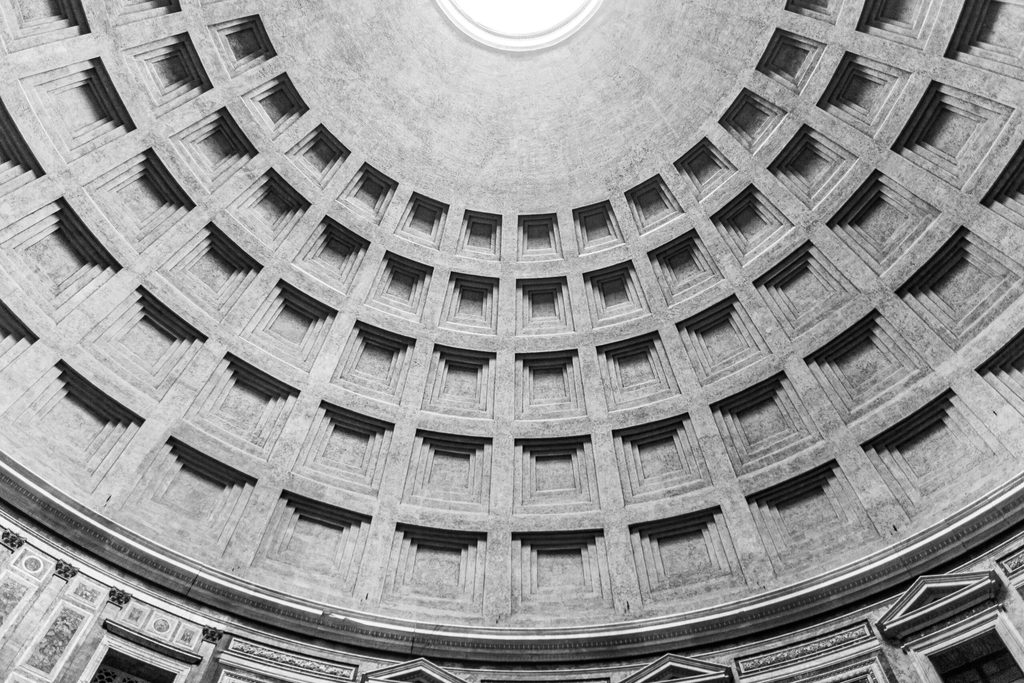
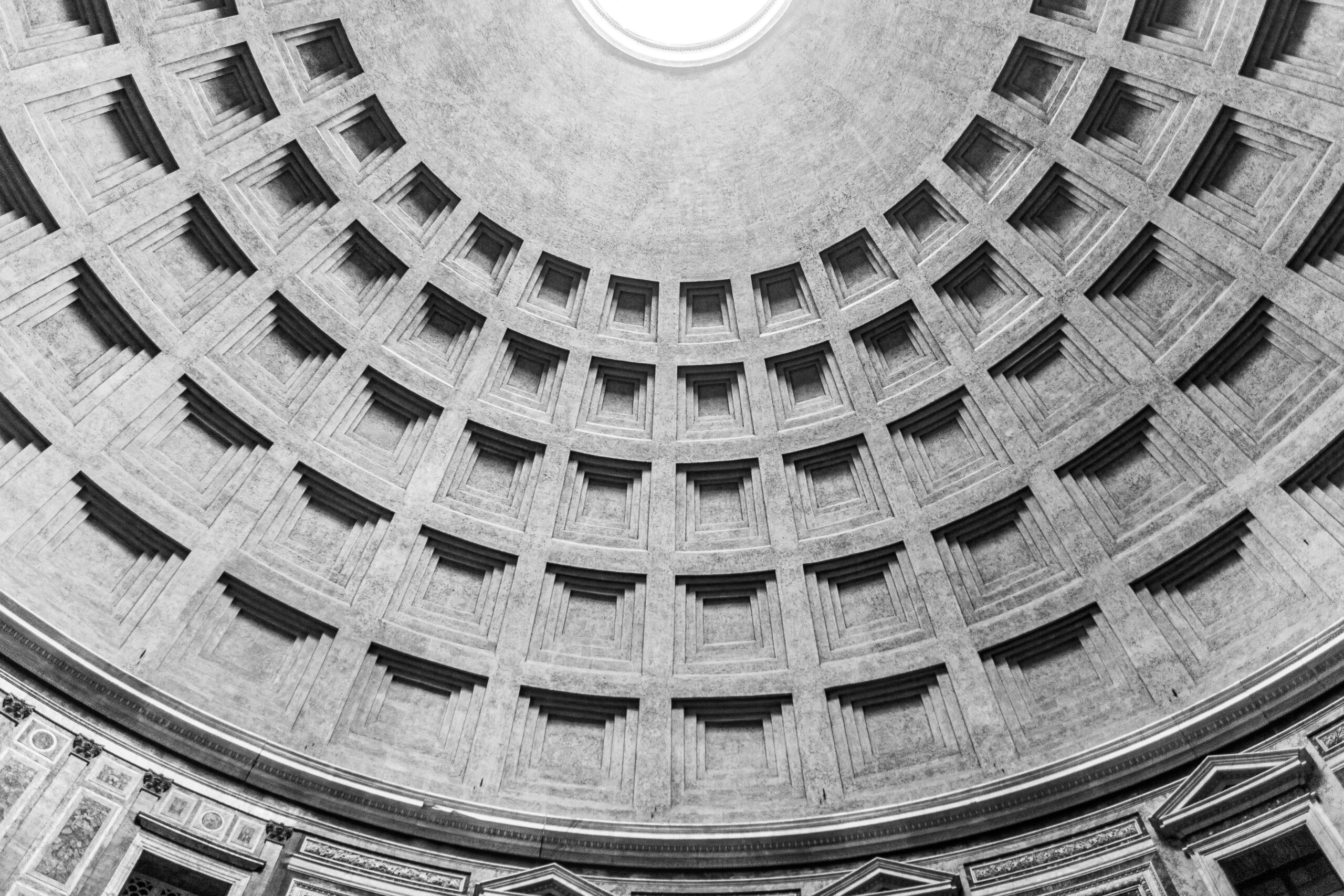
The Pantheon in Rome is crowned by a massive concrete dome some 43 metres across — without a single steel reinforcing bar. It was completed in the early second century, under Hadrian, and has gone on doing its job as a roof for almost 1,900 years.[1] Rome has many other concrete structures like it. Some have collapsed and some are badly worn, but a remarkable number still hold their shape.
In the history of building, they are anomalies. Concrete structures are normally fated to deteriorate and crumble with age. Engineers know this and calculate a service life accordingly; as that limit approaches, the structure has to be properly inspected and repaired.
And yet the Pantheon still stands. That is astonishing — though, of course, the modern architects and conservators who look after it deserve much of the credit.
By its nature, concrete is something that cracks and fails.
In January 2025, an intersection in Yashio, a city just north of Tokyo, suddenly caved in, swallowing a lorry and its driver — a terrible accident.[2] The cause was a corroded sewer main beneath the road. Over many years the corrosion had spread until the ground finally gave way.
Why does Roman concrete last two thousand years, while ours starts groaning after a few decades? Research over the past few years has begun to answer part of that question — and the answer leads all the way to another: why the Roman Empire could no longer keep its infrastructure going.
Little white lumps
Break open a piece of ancient Roman concrete and you’ll find it speckled with white grains a few millimetres across: lumps of lime known as “lime clasts”. For a long time researchers took them as evidence of sloppy mixing. Concrete is made by combining cement, sand, gravel and water in the right proportions, and it’s a temperamental material — get the mix wrong and its strength suffers. The Romans, lacking modern structural calculations, must simply have botched it. So the thinking went.
In 2023, a team led by Admir Masic at MIT offered the opposite reading. The white lumps were not a mistake, they argued, but the inevitable by-product of a particular method: “hot mixing”.
One of cement’s raw materials is lime. Normally, lime is first reacted with water to make slaked lime before it’s used.[3] Roman builders, it seems, skipped that step and mixed quicklime directly with volcanic ash and water. Quicklime reacts violently with water, giving off intense heat and making the mix set faster. Lime that didn’t fully react was left behind inside — as those white lumps.
In 2025, at a building site in Pompeii frozen mid-construction by the eruption of Vesuvius, researchers reported piles of quicklime and volcanic material that had been pre-mixed dry. The hypothesis is now being borne out by physical evidence from a real Roman work site.
Hot mixing: turning water into an ally
The white lumps come into their own long after the concrete has been laid. A crack opens; rainwater seeps in. The lumps dissolve, producing calcium-rich water, which then hardens inside the crack as calcium carbonate and seals the wound.
For concrete, water is ordinarily the root of all decay. Roman builders turned it into a repair material.
What we mustn’t conclude is that Roman concrete is “stronger”. In resistance to crushing, modern Portland cement wins easily. Modern concrete is designed to maximise early strength and speed of construction, and then to be kept going through inspection, repair and, eventually, replacement.
Roman concrete placed a different bet: not on rigidity but on resilience. It heals itself without human help. It’s almost as if it had been designed with a future in mind in which no one would be left to look after it.
The recipe survived
So why did the technique die out? “Because the recipe was lost,” people often say. I used to assume as much myself — that there were simply no longer people who knew how to make it. But the truth is a little different.
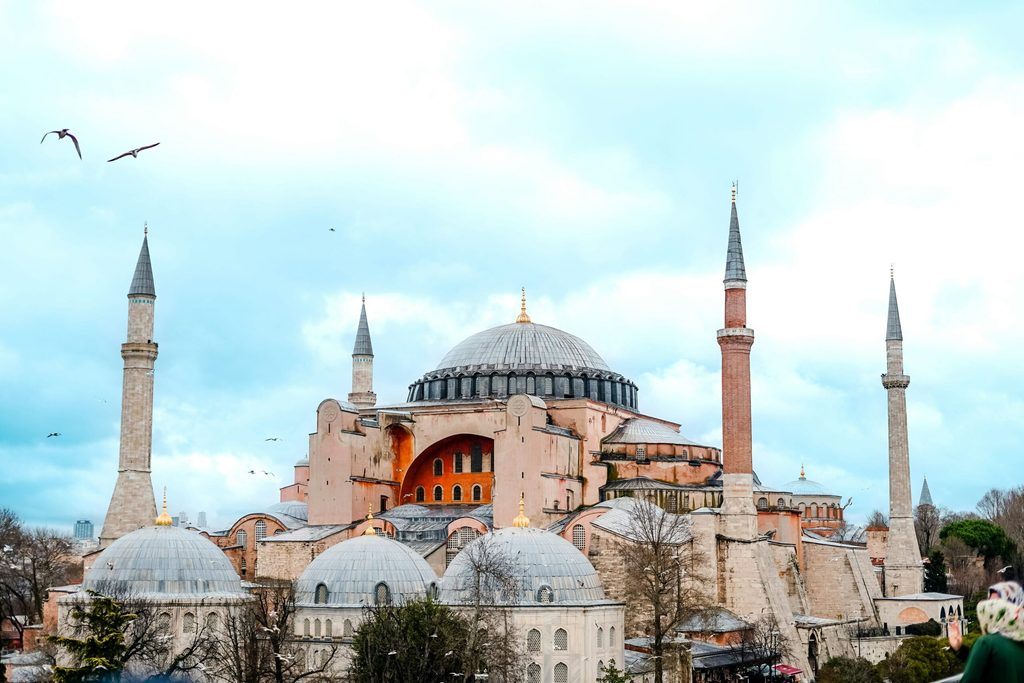
De architectura, by the Roman architect Vitruvius, survived in monastery copies throughout the Middle Ages and went on being read.[4] In the Eastern Roman Empire, monumental buildings bound with mortar kept going up; in the sixth century came Hagia Sophia. The recipe for building in concrete had not vanished.
More intriguing still, Vitruvius recommends that lime be thoroughly slaked before use — if anything, the opposite of the hot mixing practised on that site at Pompeii.
The crucial secret of Roman concrete, in other words, was never in the book. It lived in the hands of the builders on site, as tacit knowledge.[5] When the textbook and the work site disagree, it’s usually the site that’s right. And a work site, unlike a book, cannot be copied out by a monk.
When the system disappears: Britain after Rome
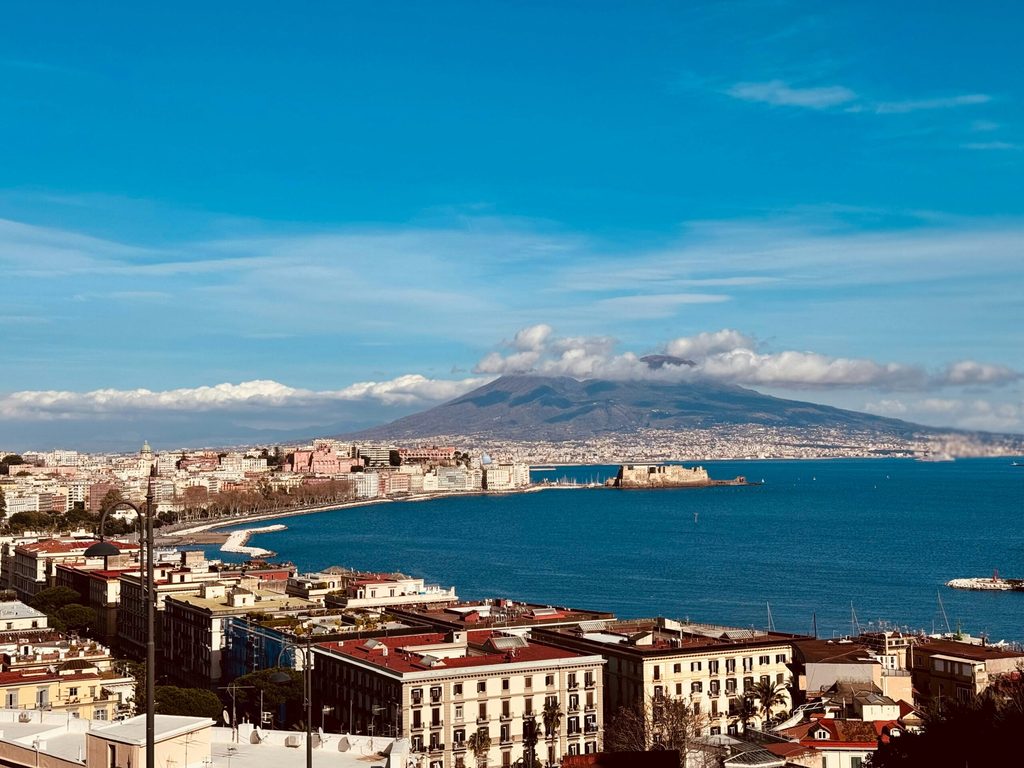
What kept the technique alive was not only the builders’ skill. Infrastructure mattered enormously. In every age, sustaining an advanced technology requires robust infrastructure and people to run it. We know the Roman Empire had a transport network carrying volcanic ash from the shores of the Bay of Naples.[6] It had kilns and fuel for burning lime in vast quantities. And above all, it had a state that collected taxes and kept on commissioning harbours, aqueducts and baths.
When the Western Roman Empire came apart in the fifth century, that chain broke at the root. Who commissions public works? The state, naturally. Without commissions, sites don’t run; without running sites, apprentices aren’t trained. The handing-on of tacit knowledge is far more fragile than it looks. Once it stops being used, it can evaporate within a single generation.
The Oxford archaeologist Bryan Ward-Perkins has shown from the archaeological record how, in post-Roman Britain, even “ordinary” goods — tiled roofs, wheel-thrown pottery — disappeared. The more sophisticated a technology, the more it depends on a network of specialised labour. When the network shrinks, you can’t reproduce the thing even with the recipe in your hands.
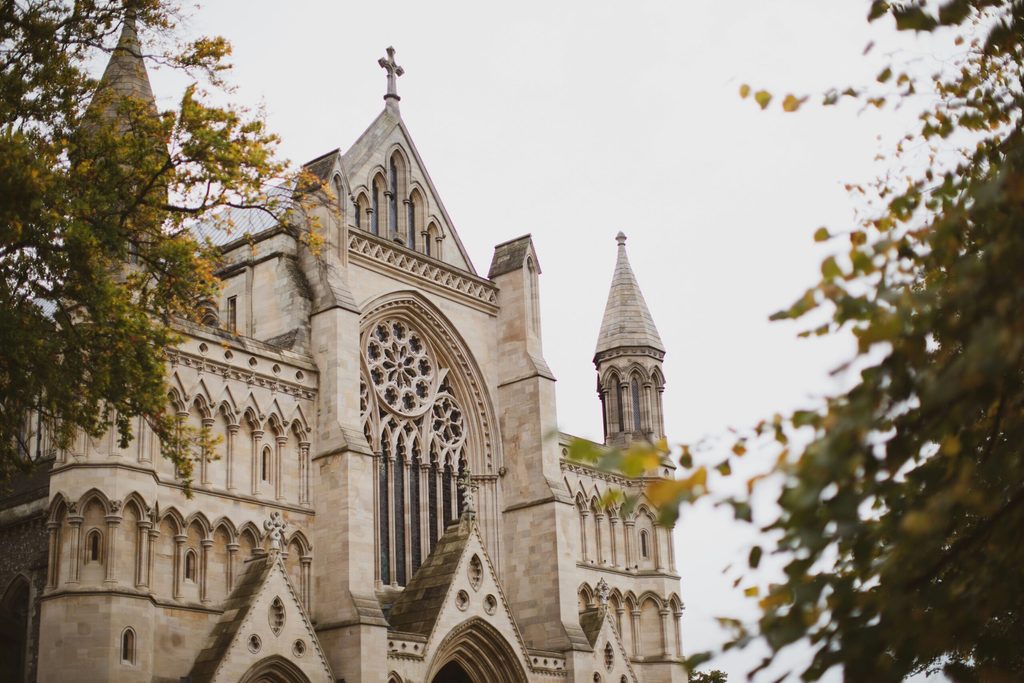
There’s a video game, Assassin’s Creed Valhalla, set in England in the age of the Heptarchy — the patchwork of Anglo-Saxon kingdoms.[7] At one point you visit St Albans Abbey as it was then, rebuilt from historical sources with real care. So faithfully, in fact, that I was shocked by how little it resembles the building today.
There are tiled roofs in the game, but every one of them is falling apart. By then nobody could fire roof tiles any more; people patched things together from Roman leftovers and, when they had to, stripped materials from ruins. The game’s St Albans looks nothing like today’s imposing cathedral — it’s a shambles. Only in the eleventh century was the abbey’s tower raised, out of brick salvaged from the ruins of Roman Verulamium, setting it on the road to the cathedral we know. The objects survived. The skill to make them did not.
The anthropologist Joseph Tainter argued that complex societies collapse when they can no longer bear the cost of sustaining their own complexity. Infrastructure is maintenance cost in its purest form. It is the barometer of whether a society can still hold its complexity together.
Where Japan stands
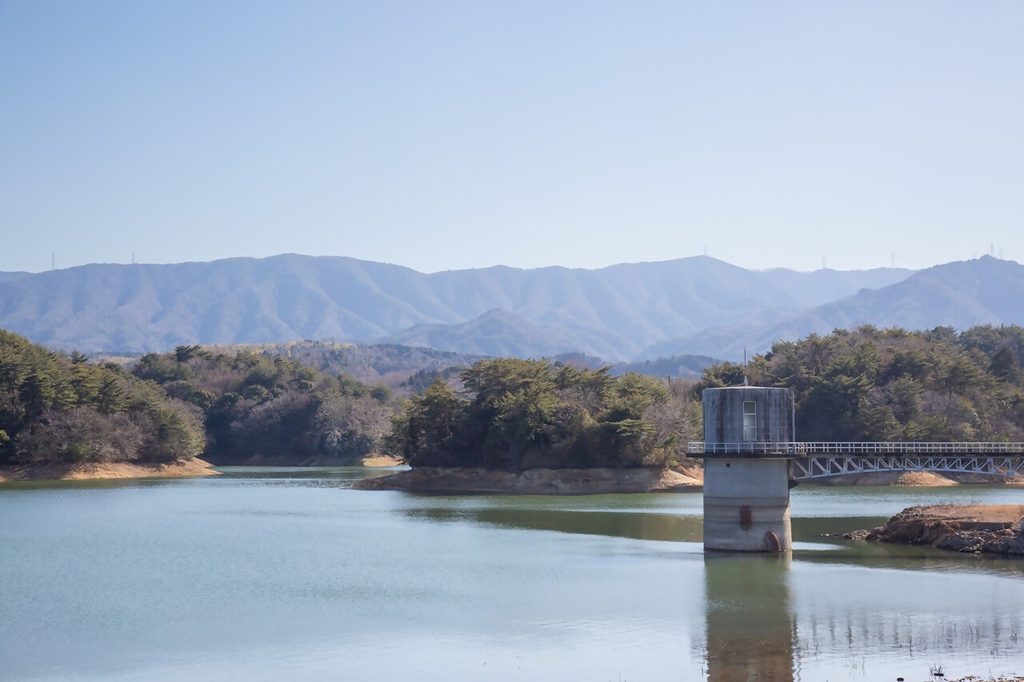
Manno-ike: infrastructure on a grand scale
Let me bring us back to Japan.
I believe Japan bears the same ruts that Rome wore into the road. One example is Manno-ike, a vast irrigation reservoir on the island of Shikoku.[8] Provincial governors had spent years failing to mend a breach in its dam; then in 821, so the story goes, the monk Kūkai repaired it in short order.[9] Legends of Kūkai — better known in Japan by his posthumous title, Kōbō Daishi — are scattered the length of the country, and this is one more. But I suspect he succeeded not through supernatural powers but because he was a superb practical organiser, a born site manager: on top of what he had learnt in Tang China, he had the gift of marshalling the people who flocked to him. (He may have had spiritual powers as well, of course, but that is a story for another article.)
Yet when Manno-ike burst again in a flood in 1184, it was abandoned for some 450 years. A village grew up on the old lakebed. The reservoir was not filled again until 1631, early in the Edo period. Even infrastructure built by a genius can be lost for centuries once the system for maintaining it breaks down. Without a stable structure of governance, infrastructure can’t be kept up — and the people who would inherit the skills disappear too.
Now to Japan today.
In 2012, ceiling panels collapsed inside the Sasago Tunnel on the Chūō Expressway west of Tokyo, killing nine people.[10] In response, the government made inspections of bridges and tunnels mandatory every five years. The inspection guidelines are in place; the manuals are thorough.
What’s missing are the people and the money to make them work. Plenty of municipalities have almost no civil engineers on staff. The construction workforce is ageing, and the supply of young recruits keeps shrinking. As the population falls, so does the tax base.
The teachers are the first to go
One case is emblematic. In September 2023, steel beams fell at a redevelopment site in Yaesu, beside Tokyo Station, killing two workers. In September 2026, Japanese media including the Nikkei and the Asahi Shimbun reported that police had referred two employees of the contractor, Obayashi Corporation, to prosecutors.
According to those reports, the load calculations for the temporary shoring meant to hold up the steelwork left out the weight of three of the five beams it was supposed to carry.[11] The site manager who did the sums had reportedly never been responsible for shoring calculations before. The company that leased out the shoring had flagged the shortfall when the order was placed. But the calculation was never corrected, and a superior signed it off without catching the error.
This is not simply a story of one person’s carelessness. Someone who understood was there. But that person was not inside the main contractor; they were at an outside specialist — the leasing company. And upstream, there was no one able to hear what they were saying.
Those responsible must, of course, face the consequences. But here too, unless we look at the system itself, we won’t reach the root of the problem.
Behind it lies a distortion in the age structure. During Japan’s “employment ice age”, companies slashed graduate hiring.[12] As a result, many firms are thin in exactly the cohort that ought now to be the backbone of the work site, passing on its skills. Between those who teach and those who learn, an entire generation is missing.
The anthropologist Joseph Henrich has pointed out that when a population shrinks, the technologies it has accumulated can be lost. Tasmania, cut off from the Australian mainland by rising seas, is thought to have lost its bone tools and fishing techniques. Knowledge does not live in books; it lives between people.
It’s easy to tell the decline of Rome as a tale of barbarian invasions and imperial misrule. But seen through the lens of infrastructure, it is also the story of the people who kept things running disappearing. And I can’t shake the feeling that this story looks uncannily like Japan today.
The biggest book ever written
The Romans had concrete that could heal itself without human hands. Even so, when the people who made it disappeared, the technique disappeared with them.
Today we hold a book far bigger than anything Vitruvius wrote: generative AI. From it we can draw almost any knowledge that has ever been written down. But just as the secret of Roman concrete was never in the book, the heart of a skill often lies precisely where nothing is written. That is tacit knowledge — what you acquire by using your hands, getting it wrong, and listening to the people who went before you.
AI isn’t the villain. The problem comes when we decide we can just leave things to it, and so thin out the people who work with their hands — and the people who grow up beside them. The smarter our tools become, the more we need humans who can spot their mistakes. Just as no one at Yaesu was able to hear the specialist’s warning, if no one is left who can catch an AI’s errors, accidents will happen. And no one will be able to say where responsibility lies.
Two thousand years on, researchers at MIT are trying to bring hot mixing back to life. Lost wisdom has found its way home by a long detour — but only at the price of a gap measured in millennia.
And yet there is a system that seems almost to have foreseen such gaps. It is a very Japanese one.
Rebuilding in order to remember: the Shikinen Sengū
The Grand Shrine of Ise keeps a practice called the Shikinen Sengū.[13] Every twenty years its sanctuaries are rebuilt from scratch, a rite that has continued for more than 1,300 years. Why twenty years? Theories vary: the lifespan of thatch and of posts sunk straight into the earth, or the Shinto ideal of tokowaka — of remaining forever young and fresh.[14] But the effect is that the shrine carpenters, and the artisans who make the sacred treasures, get to take part in the same work two or three times in a lifetime. You watch as an apprentice, carry the load in mid-career, and teach as a master. It is a system that guarantees, as an institution, that the commissions will never stop.
Rome built permanence into the object, with its self-healing concrete. Ise built permanence into the people. It deliberately rebuilds the building, and preserves instead the circle of people who carry the craft. In Rome, the buildings remained and the skill vanished. At Ise, you might say, the buildings vanish and the skill remains.
That said, it would be wrong to wrap this up in a feel-good story about how “the Japanese have always cherished their craftsmen”. The Ise rebuilding, too, lapsed for more than a century during the turmoil of the Warring States period. What revived it were fund-raising campaigns led by the nuns of Keikōin, a convent at Ise, and the wealth of the warlords who went on to unify the country.[15] It wasn’t national character that saved the craft. It was having a mechanism built to keep things from lapsing — and, each time it began to break, someone choosing, deliberately, to repair it. If Japan has stayed Japan, I suspect it owes that less to sentiment than to this mechanism and this will. It is, in the end, the work of people, and that is where I want us to look.
If we carry on as we are, modern Japan will end up following Rome down the same road — and this time with Pandora’s box, in the form of AI, flung wide open. Amid all this, there are people working desperately to carry their skills, and the care behind them, through to the next generation. We must never forget them, and we must never turn a cold shoulder to them.
We can still avoid that gap. What we need, I think, is a small Sengū in every workplace. Keep giving work to writers, to photographers, to designers, to craftspeople. Keep putting young people beside them. Rather than preserving the recipe, keep the circle of people who use it unbroken.
For all that, our ancestors and those who came before us did, somehow, manage to pull it off — passing things on from person to person. That, I think, is why civilised society exists at all. Such practices often hang on particular individuals. Japan, I believe, found a way to fold that dependence on individuals into its culture and keep it going.
Rome didn’t lose the recipe. It lost the people who kept the recipe alive. We shouldn’t make the same mistake — not when we have such a rich history and culture of handing things on, and not while we still have the luxury of stepping back to survey history as a whole.
Which is why I plan to go back and study the Shikinen Sengū, and the idea of tokowaka, in more depth.
Finally, my deepest condolences to all who have lost their lives in workplace accidents, and my sympathy to everyone affected by these disasters.
A Japanese version of this essay first appeared on junpeitakeya.com.
A Japanese version of this essay first appeared on junpeitakeya.com. This English adaptation was prepared with the help of AI and revised by the author.
Notes
- Pantheon — Rebuilt under Hadrian (r. 117–138) in the early second century. Its dome, about 43 m across, remains one of the largest unreinforced concrete domes in the world.
- Yashio road collapse — January 2025, Saitama Prefecture. A lorry fell into a sinkhole at an intersection and its driver died; the cause was attributed to a damaged, ageing sewer main.
- Quicklime and slaked lime — Quicklime (calcium oxide) is made by burning limestone. Add water and it heats up and becomes slaked lime (calcium hydroxide). “Hot mixing” skips the slaking and adds quicklime straight to the mix.
- Vitruvius, De architectura — Written in the first century BC; the oldest surviving treatise on architecture, in ten books, covering materials and construction methods.
- Tacit knowledge — Knowledge rooted in experience and the body, hard to put into words or manuals. The term comes from the philosopher Michael Polanyi.
- Volcanic ash from the Bay of Naples — Quarried around Pozzuoli and known as pozzolana, it was the key ingredient of Roman concrete.
- Assassin’s Creed Valhalla — Action RPG released by Ubisoft in 2020, set during the Viking incursions into ninth-century England.
- Manno-ike — In Mannō, Kagawa Prefecture; among the largest irrigation reservoirs in Japan, said to date from the early eighth century.
- Kūkai (774–835) — Buddhist monk who studied esoteric Buddhism in China and founded the Shingon school. Also celebrated as a calligrapher, engineer and educator.
- Sasago Tunnel collapse — December 2012. Following it, close visual inspection of bridges and tunnels every five years became mandatory from 2014.
- Shoring — Temporary props and frames that hold a structure up during construction until it can stand on its own.
- Employment ice age — Roughly the mid-1990s to the mid-2000s, after Japan’s bubble economy burst, when graduate hiring was drastically cut.
- Shikinen Sengū — The periodic rebuilding of a shrine’s sanctuaries and transfer of the deity to the new ones. At Ise it takes place every twenty years; the 62nd was held in 2013.
- Tokowaka — A Shinto ideal that values staying ever young and fresh. Thatched roofs and earth-fast posts, which rot at the base, also wear out on roughly this timescale.
- Keikōin and kanjin — Keikōin was a Buddhist convent at Ise whose abbesses raised funds through kanjin — public appeals for donations to build or repair temples and shrines — and revived the Sengū after its lapse in the Warring States period.
Notes compiled by the author.
References
Papers
- Seymour, L. M., Maragh, J., Sabatini, P., Di Tommaso, M., Weaver, J. C., & Masic, A. (2023). “Hot mixing: Mechanistic insights into the durability of ancient Roman concrete.” Science Advances, 9(1). doi:10.1126/sciadv.add1602
- Vaserman, E., Weaver, J. C., Hayhow, C., Bergmann, K., et al., & Masic, A. (2025). “An unfinished Pompeian construction site reveals ancient Roman building technology.” Nature Communications, 16. nature.com
Books
- Bryan Ward-Perkins, The Fall of Rome and the End of Civilization, Oxford University Press, 2005.
- Joseph A. Tainter, The Collapse of Complex Societies, Cambridge University Press, 1988.
- Lynne C. Lancaster, Concrete Vaulted Construction in Imperial Rome, Cambridge University Press, 2005.
- Joseph Henrich, The Secret of Our Success, Princeton University Press, 2016.
- Vitruvius, Ten Books on Architecture, trans. Ingrid D. Rowland, Cambridge University Press, 1999.
- Michael Polanyi, The Tacit Dimension, Doubleday, 1966.
- Takashi Minamikawa, Shin Rōma Teikoku Suibōshi (A New History of the Decline and Fall of the Roman Empire), Iwanami Shinsho, 2013 (in Japanese).
Web and press
- MIT News, “Pompeii offers insights into ancient Roman building technology”, December 2025. news.mit.edu
- Oxford Roman Economy Project, University of Oxford. oxrep.classics.ox.ac.uk
- Ise Jingu, official website. isejingu.or.jp/en
- Nikkei, report on the Yaesu steel-beam accident and the referral of Obayashi staff to prosecutors (in Japanese). nikkei.com
- Asahi Shimbun, report on the Yaesu accident and calculation error (in Japanese). link
- Obayashi Corporation, statement on the accident during steel erection at the Yaesu 1-chome East B redevelopment, 19 September 2023 (in Japanese). obayashi.co.jp