Zeami, Sado, and the self-taught man from Niigata
2026年10月14日 · @Junpei Takeya
A book I live by
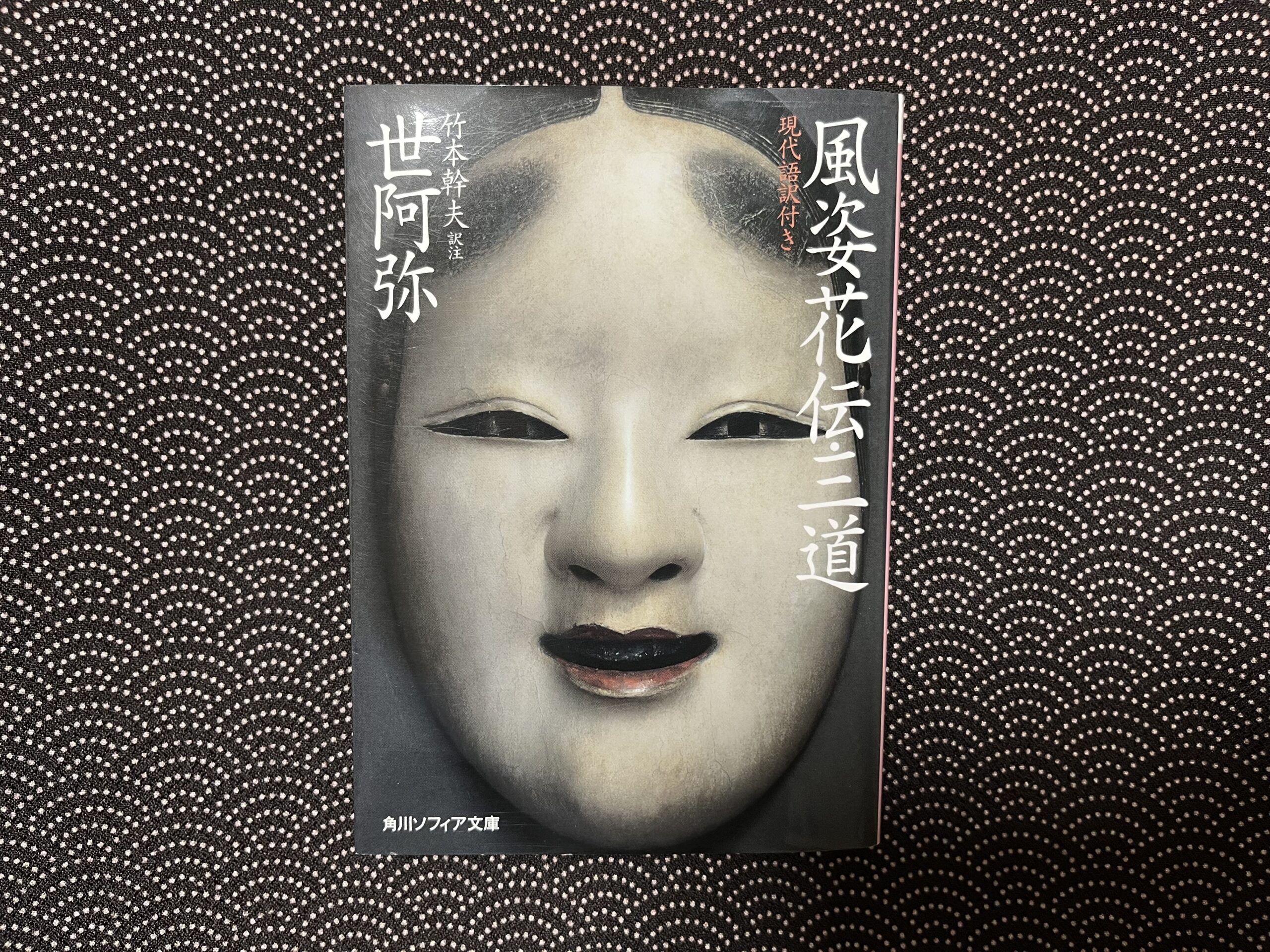
For the past ten years or so, I have carried a rather thick paperback in the inside pocket of my jacket. It is bulkier than anything sensible people keep in a pocket, yet I cannot bring myself to leave it behind. I read it for what it teaches, but I also carry it the way some people carry a charm. The book is Fūshikaden, a treatise on Noh theatre that Zeami Motokiyo began writing around 1400. I own it as an ebook too. But some books want to be opened at random, on a train or in a café between interviews, and this is one of them. It is not, I should add, an easy read.
I confess it took me years to read it properly. The classical Japanese is dense, and the book was never meant for readers like me. It was a secret manual, written solely for the heir of a theatre troupe, and it stayed sealed inside the family for some five hundred years.
Yet when I finally sat down with it, I noticed something unexpected. This is not a lofty essay on aesthetics. It is a survival guide for people who earn their living in front of an audience.
It was written for performers, the actors of sarugaku, the popular theatre from which Noh grew. And it was meant to be intensely private. Zeami’s rule was that the teaching should pass to only one person in each generation, and he went further: not even a son should receive it if he lacked the talent. Yet the more I read, the more another thought took hold. This is also a handbook for freelancers.
I live in Niigata, on Japan’s Sea of Japan coast, and work as a freelance writer and interviewer. I recognised myself on almost every page.
The twenty-first century, I think, belongs increasingly to freelancers. Over the past decade, “digital nomad” has become a word everyone understands. Several European countries now issue digital nomad visas, and Japan introduced one in 2024. When I look closely at the nomads who survive and keep growing stronger, I see a remarkable number of echoes of this book.
The book also has an unexpectedly close link to Niigata. Zeami was not born here, but in old age he was exiled to Sado, the large island that lies off our coast. And when the book finally emerged from centuries of secrecy, one of the people who brought it into the light was a man from Niigata.
So this letter is about that book, about an island I can see from the beach near my home, and about the self-taught man from my own city who made it possible for any of us to read Zeami at all.
A manual for those who live by applause
Noh in Zeami’s day was not the hushed, state-protected tradition it is now. It had grown out of sarugaku, a lively popular entertainment. Troupes competed for patrons and for slots at temple and shrine festivals, and they had to please whoever happened to be watching. A run of empty houses meant hunger. Zeami wrote for that world. The metaphor that runs through the whole book is hana, the flower: whatever it is that makes an audience lean forward.
His first warning is aimed at the young and successful. An actor of twenty-four or twenty-five is praised everywhere and may come to believe he has mastered his art. He has not.
“The flower of this age is not the true flower. It is only the flower of the moment.”
It is a bloom borrowed from youth and novelty. Mistake it for the true flower, and you stop growing at the very moment the borrowed bloom begins to fade.
I now recall the next line every time I pitch an idea.
“The flower, the interesting and the novel: these three are one and the same.”
People are moved by freshness. Zeami is not asking for gimmicks, though. The same piece, offered at a different moment or in a different light, can feel new. Its companion is another short sentence: know, above all, that the flower is having no fixed place to dwell. Keep a style, but never settle into it.
The most famous phrase in the book is hisureba hana: what is hidden is the flower. It is often read as a celebration of Japanese reticence. Put back in context, it is far more practical. A surprise works only because the audience does not see it coming. Show your hand and the effect is gone. Anyone who has watched a proposal fail because it explained too much will nod at this.
It is precisely when expectations are overturned, in the best sense, that people are moved. Looking back, the slogans, articles and proposals of mine that really landed all did exactly this.
The flower, the interesting and the novel are a single quality. I suspect it will only become more valuable as AI spreads. The models will keep improving, and so will the craft of prompting them. But the final push, I believe, will still need that one quality.
Zeami is frank about luck, too.
“Even within a brief span of time, there are otoko-doki and me-doki.”
These are the rising and ebbing tides of fortune: moments when luck runs with you, and moments when it runs against you. In the ebb, do not force a win; save your strength and wait for the tide to turn. For a freelancer whose work arrives in unpredictable waves, I know of no more consoling advice.
And beneath it all lies a blunt commercial truth.
“This art exists to win the affection of the many, and that affection is the blessing that keeps the troupe alive.”
Zeami even advises adjusting a performance to suit a provincial crowd rather than a discerning audience in the capital. I know of no more honest sentence about making a living from culture.
The beautiful boy and the exiled old man
The warning about the flower of the moment gains weight once you know who wrote it. In the 1370s, a boy of about twelve called Fujiwaka appeared on stage with his father, the actor Kan’ami, at Imagumano in Kyoto. In the audience sat the young shogun, Ashikaga Yoshimitsu. He was captivated, and the boy who would become Zeami was taken into his favour.
We know Fujiwaka was strikingly beautiful because the age’s leading man of letters said so. Nijō Yoshimoto, imperial regent and master of linked verse, praised the boy’s looks and bearing, and even his skill at court kickball and poetry, in a letter so effusive that it still reads like fan mail. Not everyone was charmed. One courtier noted in his diary, with open distaste, that the shogun had invited this child of lowly entertainers to share his viewing box at the Gion festival.
Zeami, in other words, knew the flower of the moment more intimately than almost anyone. He watched it bloom, and he watched it fall. When he warns his heir not to trust early praise, he is not moralising. He is remembering.
The end of his life was harder still. In 1434, at around seventy-two, he fell out of favour with a later shogun, Ashikaga Yoshinori, and was banished to Sado, off the Niigata coast. On the island he wrote Kintōsho, a slim collection of short chanted pieces describing his voyage and the island’s temples, shrines and landscapes. What moves readers is its calm. There is almost no bitterness in it, only an old man still looking closely at the world.
In Fūshikaden, Zeami describes his father’s last performance, shortly before his death at fifty-two, as proof of a flower that remained in old bones. Reading Kintōsho, it is hard not to think the same of Zeami himself.
Sado went on to become one of Japan’s great Noh islands. More than thirty Noh stages survive there, often said to be about a third of the national total, most of them attached to village shrines. The more direct cause was Ōkubo Nagayasu, Sado’s magistrate in the early seventeenth century, who came from a family of Noh performers. Even so, islanders have long taken quiet pride in being the place where Zeami was sent.
My paternal grandfather and my maternal grandmother were both born on Sado, so I spent a good deal of time there as a child, and I saw torchlit Noh more than once. Noh is famous for a quality called yūgen, a word with no real equivalent in English. As a small boy I could not possibly have understood it. But when a demon mask rose out of the darkness, I was sure it had come to carry me off to the other world. The stage seemed to me a borderland between this world and the next. The chanted words were Japanese, yet I could not follow them, and I had no idea who any of the characters were. More than anything, the solemn grandeur of it simply overwhelmed me.
If I had to sum up what draws me to Noh now, I would put it like this: an ultimate Japanese art that fuses beauty, a trace of the uncanny, and a fleeting sense of being here, now.
On Sado you can see this art without ceremony, and it is mostly performed by the islanders themselves. Watching Noh there is an experience you will not find anywhere else in Japan.
The man who found the hidden flower
For nearly five centuries after Zeami’s death, his writings were not books in any public sense. They were copied and guarded within the Noh houses. Fūshikaden practised exactly what it preached: it was a flower kept hidden.
That changed in 1909, when a scholar named Yoshida Tōgo published an annotated edition of Zeami’s treatises, Zeami Jūrokubu-shū, the Sixteen Treatises of Zeami. The manuscripts had surfaced in a private collection, and Yoshida set them in print. Suddenly Fūshikaden, and Kintōsho too, could be read by anyone. The Zeami of Sado was no longer a line in the historical record; he could now speak in his own words. Modern Noh scholarship begins, more or less, here.
Later events made Yoshida’s work weightier still. The original manuscripts he worked from were destroyed in the Great Kantō Earthquake of 1923. For several of the treatises, his printed text is now the base text that scholars rely on. Had he not opened the box when he did, those flowers might have been lost for ever.
What moves me is who Yoshida was. He was born in 1864 into a family of farmers and foresters in a village east of Niigata city, in what is now Agano. He later married into the Yoshida family of Ōshika, today part of Niigata city. His schooling ended at primary level; everything else he taught himself. He was a prodigy of learning, and he is one of the people I admire most.
His life’s great work was not about Noh at all. It was the Dai Nihon Chimei Jisho, a monumental gazetteer of Japanese place names, compiled almost single-handed. Historical geographer, lexicographer, poet in classical Chinese, and founder of modern Noh studies: Yoshida refused to be any one thing. I sometimes describe my own working life, half in jest, as that of a hyper-hyakushō. The historian Amino Yoshihiko argued that hyakushō, usually translated as “peasant”, originally meant people of a hundred trades, not just farmers. Yoshida was the real thing.
In Agano there is a museum devoted to him, the Yoshida Tōgo Memorial Museum. Fittingly, its two main exhibitions are the place-name dictionary and the discovery of Zeami’s secret books. One more thread completes the circle. Scholars are still surveying the books and papers in Yoshida’s old house in Ōshika, and among those leading the work is Takemoto Mikio, who also translated and annotated the paperback edition of Fūshikaden that I carry in my pocket.
The flower after forty
As I write this, I have just turned forty-one. Zeami has something to say about that too, and it is not flattering.
“The rise lasts until thirty-four or thirty-five; the decline begins after forty.”
Allowing for the shorter lives of medieval Japan, I choose to add a decade or so to his numbers. Still, the point stands.
His advice for the mid-forties is not to fight the decline but to change the method. Stop taking on every intricate role. Choose what suits you, and perform it without strain. Above all, find a good supporting actor, let him take the flower, and dance quietly at his side. Then comes the line I underlined twice.
“A flower that has not faded by this age: that is the true flower.”
What remains after youth and novelty have gone is the only bloom worth having. The condition, Zeami says, is to know oneself.
For someone whose work is drawing stories out of other people, this is less a consolation than a job description. The interviewer has always been the supporting actor.
So here is where the threads meet. A beautiful boy who knew the passing flower better than anyone. An old man exiled to an island off this coast, still writing calmly about its shrines. Five centuries of silence. And a farmer’s son from Niigata, with a primary-school education, who opened the box and let the rest of us in.
On a clear evening at the beach near my home, Sado lies along the horizon. The thick little paperback is in my pocket. I open it at random, as Zeami’s book seems to ask, and read whatever line falls under my thumb. There is no hurry. This flower bloomed six hundred years ago. It can wait while I take my time.
Travel notes: in Zeami’s footsteps
To follow Zeami, base yourself on Sado and finish on the mainland in Agano. Two days are enough for the main sites on the island. Noh season runs from April to October, and June, when performances cluster, is the best month to go.
Getting there
- To Sado: from Niigata Port to Ryōtsu Port, about 1 hour 5 minutes by jetfoil or 2 hours 30 minutes by car ferry. The jetfoil must be booked in advance. In summer and during the wildflower season even second-class ferry seats can sell out, so book early.
- From Tokyo: about 2 hours by Jōetsu Shinkansen to Niigata. Buses run from Niigata Station to the ferry terminal in about 15 minutes.
- Getting around: the sites are scattered across the central Kuninaka plain. Buses exist but are infrequent, so hiring a car at Ryōtsu is the most efficient option.
1. Shōbōji Temple (Izumi)
Top choice. This Zen temple is traditionally held to be where Zeami lived in exile. In the grounds is the stone on which he is said to have sat. The temple’s treasure is a demon mask, the Shinji-men Beshimi: legend says that in a year of drought Zeami danced in it and brought heavy rain. Thought to date from the late Kamakura period, it is a designated cultural property of Niigata Prefecture.
- Tip: the mask is not normally on view. It is shown to the public during the Shōbōji Candlelight Noh in June, a performance lit by candles alone and worth planning a trip around.
- Address: 504 Izumi-kō, Sado
- Access: about 30 minutes by bus from Ryōtsu Port to Izumi stop, then 3 minutes on foot; about 13km by car. Free parking for 10 cars
- Contact: +81 259-63-2032
2. Daizen Shrine Noh Stage (Takeda)
Said to be the oldest surviving Noh stage on Sado. The thatched stage, rebuilt in 1846, stands quietly among tall cedars. Its painted backdrop shows the customary old pine together with a red sun, a design said to be unique to this shrine. The surrounding farmland is so serene that locals compare it to Asuka, the ancient heart of Japan.
- Tip: Noh is offered at the shrine festival on 18 April, and torchlit Noh with Sagi-ryū kyōgen comic theatre is staged in June. The Sagi school of kyōgen survives in only three places in Japan, and Sado is one of them.
- Address: 562-1 Takeda, Sado
- Access: about 30 minutes by car from Ryōtsu Port, or by bus to Takedabashi, then 15 minutes on foot. The grounds are open at all times
3. Sado History and Legend Museum (Mano)
Life-size animatronic figures re-enact the stories of people exiled to Sado, including a scene of Zeami’s rain dance. Alongside the retired Emperor Juntoku and the monk Nichiren, it gives a good overview of Sado as an island of exiles. A memorial hall to the metal artist Sasaki Shodō, a Living National Treasure, is attached. A good option on a rainy day.
- Address: 655 Mano, Sado
- Hours: April to November 8.30am to 5pm; December to March 9am to 4.30pm
- Admission: adults ¥800
- Access: about 30 minutes by car from Ryōtsu Port
- Contact: +81 259-55-2525
- Note: opening arrangements may change in winter, so call ahead
4. Shiizaki Suwa Shrine Noh Stage and the Ryōtsu Takigi Noh (Haraguro)
If you want to see Noh on Sado, start here. On a shrine stage overlooking Lake Kamo, torchlit Noh is performed about once a month from spring to autumn, by islanders trained under the Honma family, Sado’s hereditary masters of the Hōshō school. Lit by bonfires, the stage carries something of the open-air theatre Zeami himself would have known.
- 2026 performances: 5 May, 13 June, 22 September and 12 October (special performance), all starting at 7.30pm
- Admission: ¥2,500 contribution (¥4,000 for the special performance). No booking needed
- Access: about 5 minutes by car from Ryōtsu Port
- Tip: in rain the venue may move to the Kanai Noh Theatre. No flash photography and no video
- Contact: Ryōtsu Takigi Noh committee, +81 259-23-3300
5. Zeami’s Road (Matsugasaki to Kasatori Pass)
The mountain road Zeami is said to have taken from his landing place to his place of exile. It runs from Matsugasaki on the east coast of southern Sado over Kasatori Pass and down into the Kuninaka plain, letting you retrace the journey described in Kintōsho. In autumn the hills are a blaze of colour.
- Tip: this is not a developed walking trail. If you plan to hike, check conditions at a local tourist office first. Even driving over the pass gives a feel for the distances Zeami travelled
- Access: roughly 40 minutes by car from Ryōtsu Port towards Matsugasaki (estimate)
Also worth it: Yoshida Tōgo Memorial Museum (Yasuda, Agano)
Back on the mainland, end your journey here. The museum stands in the birthplace of Yoshida Tōgo, the self-taught historical geographer who brought Zeami’s writings to light in 1909. Its two main exhibitions cover the place-name dictionary he compiled single-handed over thirteen years and the discovery of Zeami’s secret books; a newer display covers the Jōgan earthquake of 869, which Tōgo discussed in his research. Visit after Sado and the work of one man who bridged five centuries of silence feels suddenly close.
- Address: 1725-1 Yasuda, Agano
- Hours: 9.30am to 5pm (last entry 4.30pm)
- Closed: Mondays (or the following day if Monday is a public holiday), the day after public holidays (open if that falls on a weekend), and 28 December to 4 January
- Admission: adults ¥300, children ¥150
- Access: about 20 minutes by bus from Gosen Station (JR Ban’etsu West Line) or Suibara Station (JR Uetsu Line); about 5 minutes by car from Yasuda IC on the Ban’etsu Expressway
- Contact: +81 250-68-1200
Suggested itinerary (two days on Sado, half a day on the mainland)
- Day 1: arrive at Ryōtsu → Shōbōji → Daizen Shrine → Sado History and Legend Museum → Ryōtsu Takigi Noh in the evening (if your dates match)
- Day 2: drive Zeami’s Road → ferry from Ryōtsu back to Niigata
- Day 3: from Niigata to the Yoshida Tōgo Memorial Museum in Agano
Information correct as of October 2026. Opening hours and performance dates may change, so check with each venue before you travel.