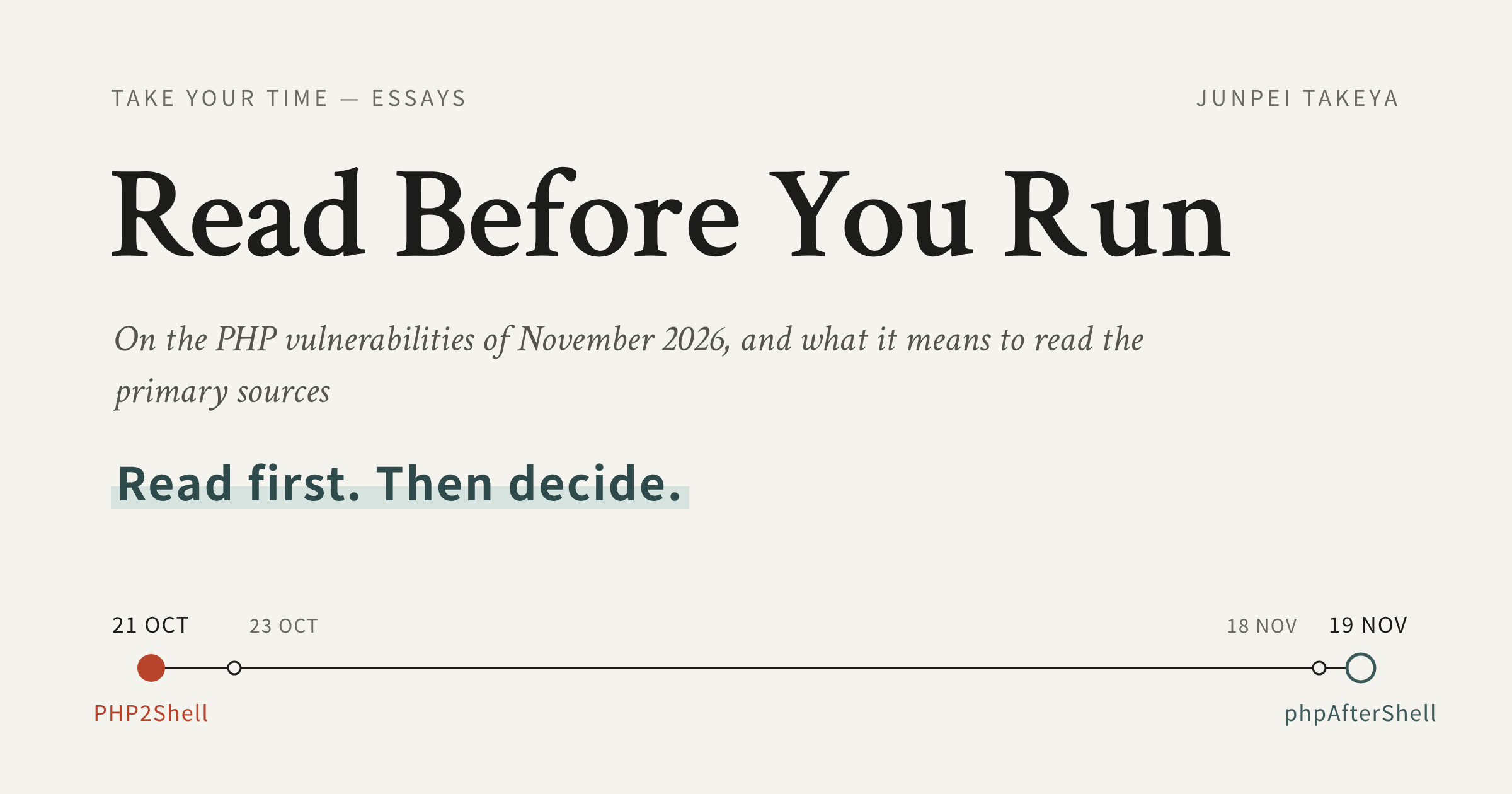
Notes on the PHP vulnerabilities of November 2026
On the morning of 19 November, I opened my phone in Niigata and found the feed already burning.
“Critical PHP vulnerability — again.” “Patch now or lose your site.” Red sirens, warning triangles, a skull or two. Most of the posts ended the same way: a link in the profile, a free consultation by direct message, a security audit at a special price.
If you have never heard of PHP, you have almost certainly used it. It is the quiet engine behind a large share of the world’s websites — blogs, shop fronts, the small pages of clinics, temples and family businesses. A month earlier, in October, a pair of flaws nicknamed PHP2Shell had sent everyone who looks after such sites into a week of sleepless patching. I was one of them. So when the word “critical” appeared again, the fear made sense.
What follows is not a technical report. It is an account of how I read the news this time, where I got it wrong, and what I think reading the news well actually means.
The notice, and my own optimism
The alarm had a source. On 18 November, the PHP security team posted a short notice: a security release would follow the next day, it would cover every supported version, and the highest severity was “critical”.
The posts quoted that word. Almost none of them quoted the sentence that came after it. The critical issues, the notice said, only affected installations with non-default configuration or uncommon setups.
I read that sentence and felt my shoulders drop. By the afternoon I had drafted an article for my Japanese readers with a calm title and a calmer conclusion: if your site runs on an ordinary setup, there is no need to panic. I explained what “critical” means. I criticised the accounts selling fear. I made a thumbnail. I was ready to publish.
I did not, in the end, publish that day. The fixes would only be released that night, Japanese time, and it felt wrong to tell people not to worry about something none of us had yet seen. That hesitation turned out to matter more than anything I had written.
What the release actually said
The new versions arrived at around eleven that night. Seventeen vulnerabilities were fixed; seven were rated critical. Most of them, read one by one, did belong to unusual setups: one version of PHP only, a particular server arrangement, an application doing something odd with its own settings.
But one of them did not. A security firm called depthfirst had found a flaw in the way PHP stores sessions — the little files that remember who you are as you move from page to page. By default, PHP keeps those sessions in files, and it rewrites them in place. If a write is interrupted at the right moment, the file is left half old and half new, and a later request can be made to load something an attacker chose. The researchers named it phpAfterShell. It sat in the default configuration, and the October patches had not closed it.
There were qualifications. To take over a server, the flaw had to be chained with a second weakness; how easy that second step is in practice is still a matter of debate among specialists. And as of the morning of 20 November, no one had reported it being used in a real attack.
Still, my conclusion from the afternoon before was no longer true. “Ordinary setups need not worry” had become “there is no need to panic, but this time you do need to update.” I rewrote the article from the top. The sites I look after, it turned out, had already been patched by their hosting company overnight. I checked, and told their owners so.
Severity is not probability
It would be easy to read this as a story about the alarmists being right. I do not think it is.
A severity rating answers one question: if this hole is open, how bad could it get? It does not answer the question most readers are actually asking: is the hole open on my site? Those are different questions, and the gap between them is where both the panic and the complacency live.
Imagine a fault discovered in a certain model of safe. Follow a particular sequence and the door swings open. Since everything inside could be taken, the fault is rated critical, and rightly so. But if you do not own that model, it is news and nothing more. And if you do own it, but the sequence is one no ordinary owner would ever perform, the picture changes again. You can only know where you stand by reading the details and holding them up against your own safe.
The accounts selling fear on the morning of the 19th had not read the details. Neither, strictly speaking, had I. I had read one reassuring sentence and stopped. Fear and optimism look like opposites, but they share a habit: both decide before reading.
We usually tell the story of the boy who cried wolf as a lesson about lying. It is also a story about villagers who were made to run so often that, when the wolf finally came, nobody moved. Every needless alarm spends a little of that attention. The sellers of fear are not only taking money; they are spending something that belongs to all of us.
What counts as a primary source
“Read the primary sources” is advice that is easy to give and harder to follow, so it is worth being precise about what it means here.
A primary source is information put out by someone who is party to the matter itself. In a case like this, there are four such parties. There is the side that fixes the flaw: the PHP team, with its release notes and its official security advisories. There is the side that found it: the researchers, whose write-ups are the most detailed account of how an attack works, though they also serve as advertising for their own firms, and their names and phrasing tend to run large. There is the side that runs your server: your hosting company, whose notices tell you whether the fix has reached you. And there is you. The version number shown in your own site’s settings is the one piece of information that no one else can give you, and there is nothing more certain.
News reports, security blogs and round-ups — this essay included — are secondary. They are useful as maps to the primary sources. But if you are going to act on something, go back to where it came from. Social media posts sit one step further away still.
This week taught me one more thing. A primary source is only ever a primary source as of a certain moment. The notice of the 18th was as primary as information gets, and its contents were deliberately withheld. The whole picture appeared only with the release of the 19th. Reading the primary sources means checking the date, and then following what comes next.
When to run, when to walk
PHP2Shell, in October, was the real thing. It could be reached on ordinary setups, it was being exploited from the first day, and the only sensible response was to drop everything and patch. This time was different. Not harmless — there was work to do — but there was time to do it properly.
There are moments when you should run, and moments when it is fine to walk. Treat every alarm as a reason to run, and you will have nothing left in your legs when it matters. Treat every alarm as a false one, and one day you will be the village that did not move. The only way to tell the two apart is to stop, read, and decide.
I think more and more of the web will be like this for a while: one alarm after another, each one shouted before it is understood. The small sites — the family clinic, the corner bakery, the neighbourhood association — cannot afford a security team, and they should not have to buy their calm from someone selling fear. What they can do, what any of us can do, is slow down long enough to read.
Take your time. Then, if you need to, run.